
Hello, this is tK, your blog correspondent.

This article is about 【New Irons】!
Just hearing these words is enough to generate excitement.
I am confident that all JUCIE fans share this sentiment.

―― The keyword is 'Reiwa Ikemen' (Handsome Man of the Reiwa Era).
It appears JUCIE is advancing the development of new irons!
As a fan, I can no longer keep silent. I want to share this with everyone!
However, much of the detail remains shrouded in secrecy.
Nevertheless, I was able to glean a small 'keyword' from Mr. Matsuyoshi this time,
and using that as a catalyst, I wish to write a little about what I personally felt and the expectations that have spontaneously grown within me.


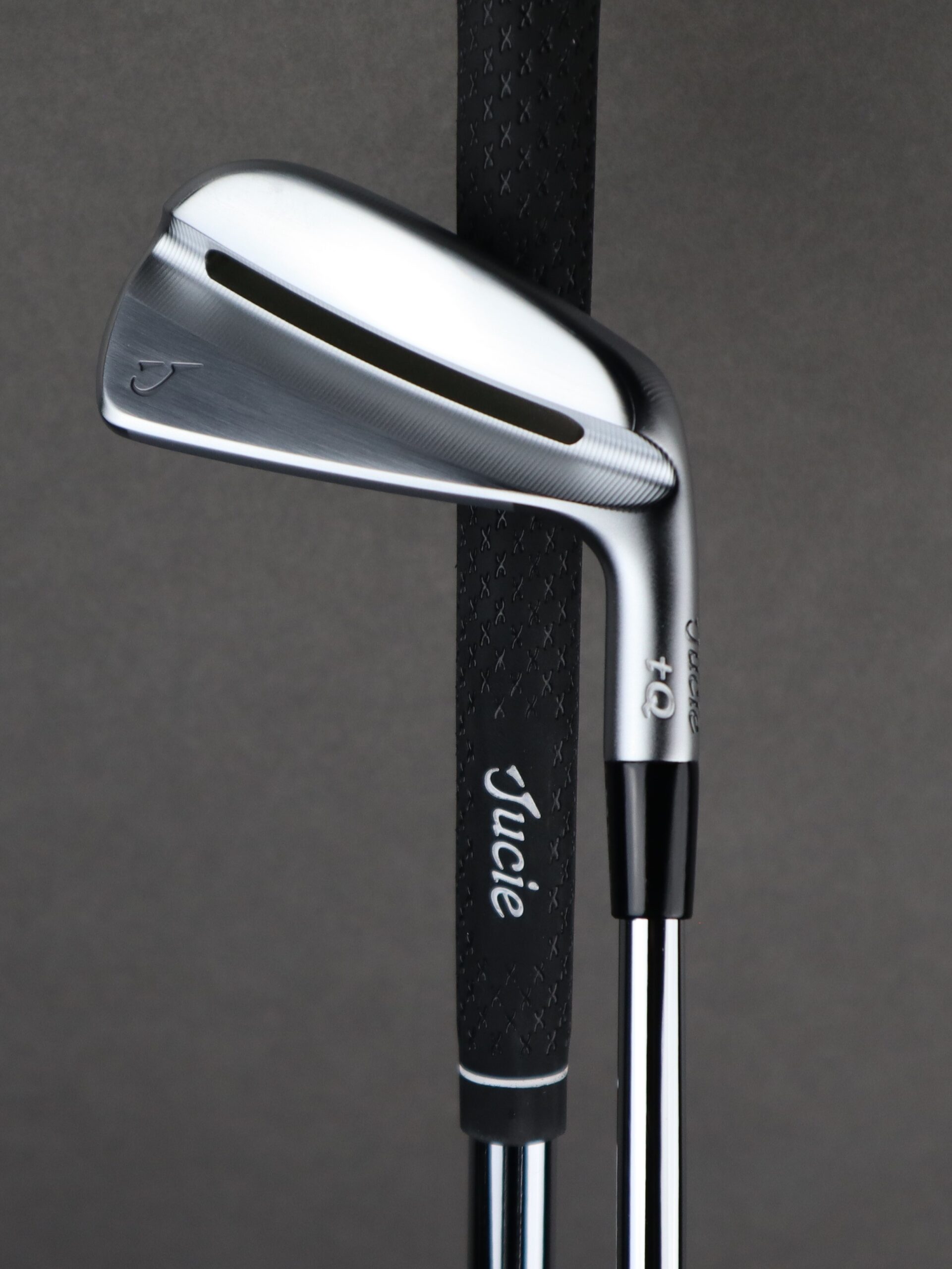
First, regarding the current model, the 'tQ Iron'

The tQ Iron is renowned for its exquisite trajectory and the unparalleled sensation when the impact point perfectly aligns with the clubface and shaft axis. I believe few clubs convey such a profound sense of 'capturing the ball squarely on the face'.
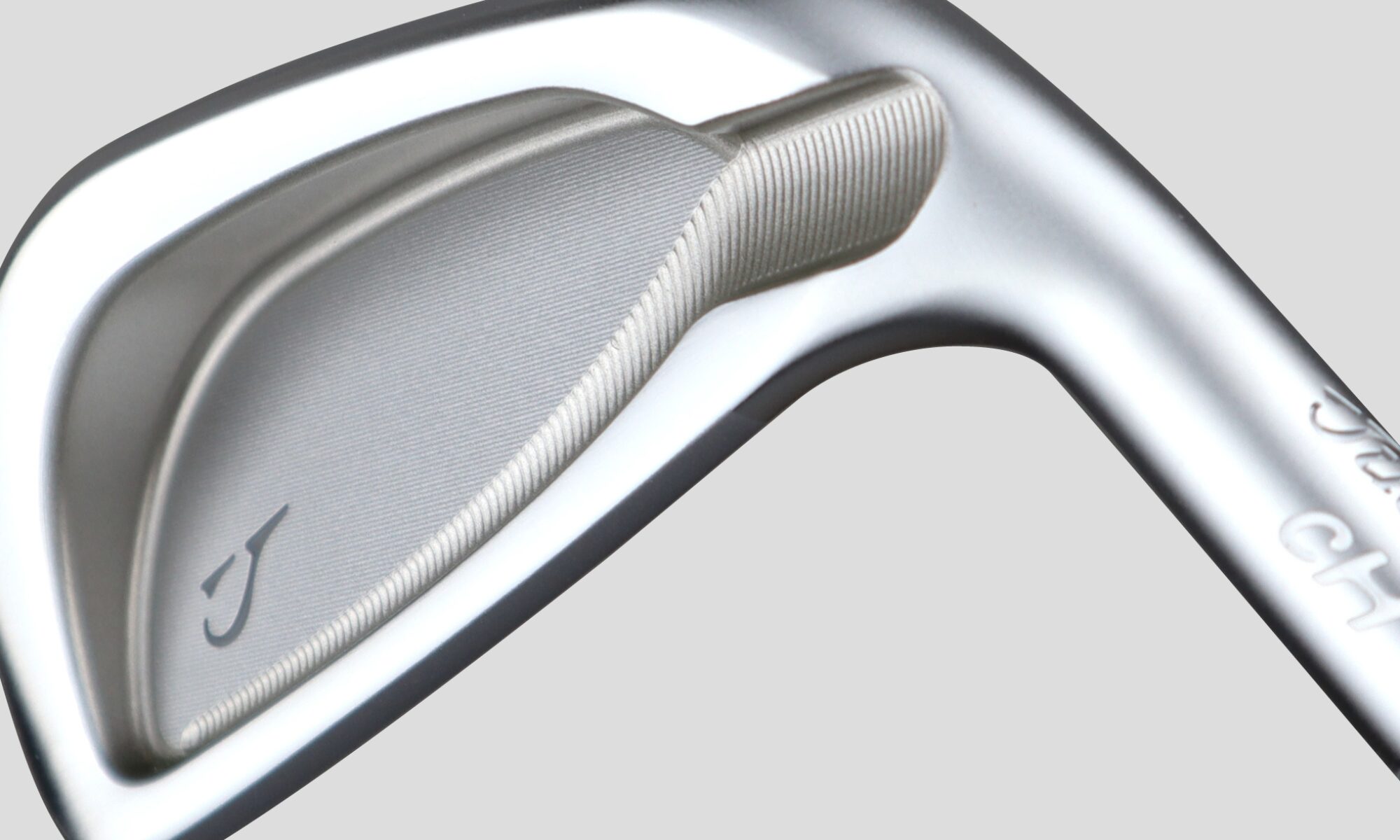
Clubs 8-iron and below feature a pure muscle-back design. They offer the joy of ball manipulation, while 7-iron and above consistently propel the ball to significant distances.

The satisfaction of a well-struck shot is exceptional, and the sheer act of hitting them progressively enhances enjoyment.
However, conversely, there is little sense of the club providing significant assistance.

Rather, it's as if the club communicates, 'If you execute properly, I will perform with precision.'
――That is the profound message one perceives from this club.

This characteristic captivates seasoned golfers who have long wielded clubs with expertise.
However, for golfers accustomed to recent clubs replete with 'assist features',
they might dismiss it with a single phrase: 'It looks difficult.'


The narrative unfolds from a single comment by a student golfer

Amidst this, an incident reportedly occurred.
Mr. Matsuyoshi had the opportunity to introduce JUCIE to a student golfer representing Japan.

Mr. Matsuyoshi approached with absolute confidence in the tQ Iron.
However, after hitting a few balls, the student reportedly stated:
“I’m not a fan of this clubhead shape. I prefer clubs that appear easier to hit.”
Mr. Matsuyoshi was reportedly quite taken aback by that remark.

The tQ irons are a legitimate model designed for golfers who have held clubs for many years and feel comfortable with them.
However, in the student's eyes, these irons were "difficult to use.


It is a matter of taste, but at that moment, a switch flipped in Matsuyoshi's mind.
I think it would be better to change the "ease of posture" that the times demand, depending on one's style of play.


New keyword: "2021 handsome men

Thus, a new keyword was born.
It is called "2021 handsome.
In the past, the individuality of each manufacturer was strongly expressed in the face (i.e., the face design at address). Nowadays, the back face design and the brand's overall world view are more influential.
Under such circumstances, JUCIE began to search for the "face of 2021.

What's more, surprisingly, the next model will have two faces within the same iron:
"2021 handsome" and "orthodox"!
Two completely different personalities coexisting in one model.
It is truly amazing to see how easily they go beyond our imagination.


Deep design thinking to the point of perversity

When talking with Mr. Matsuyoshi, his design talk goes deeper and deeper, sometimes to the point of insanity....
Just when you think you finally understand one level, there are three more levels of deep thinking beyond that.
I get the impression that he is a man who is traveling in a world that no one else can enter.

Even so, the man himself is always soft-spoken and always willing to answer any questions you may have in a polite manner.
In an appearance on a program just the other day, he was described by his co-star as "perverted" (laughs).
In this industry, I think that is one of the biggest compliments you can get.


Finally.

The full details of the new irons have not yet been revealed.
However, the key word is "2021 handsome.
It is certain that we are about to create a club that makes you feel "now" the moment you put it in your stance.
What do you feel from these words?
What kind of "face" will JUCIE show us?
As a fan of JUCIE, I look forward to that moment with great anticipation.
Please look forward to further news.

Is it time to reset conventional wisdom regarding wedge selection? -Part 2-

In the last issue, we talked about how you should focus not on absolute spin performance, but on "does it always produce the spin you expect?" I would like to talk about another uncomfortable point: "It is a waste of time to choose a wedge by giving priority to the value of the angle of the stance.
This time, I would like to talk about another uncomfortable point, which is that it is a waste of time to select wedges by giving priority to the value of the angle of the stance.


Is low-vance wedge difficult?

When was the low-vance wedge genre established...
When wedges were commonly included in iron sets, the Sw was a helpful club that was easy to use in bunkers, and when the trend toward strong lofts began to progress and the loft of the Pw was in the 40-degree range, clubs called the Then, clubs called W, Aw, Gw, P/S, etc. appeared between Pw and Sw, and simply the performance to fill the distance difference between Pw and Sw came to be demanded. After that, I feel that the clubs gradually evolved and changed into clubs specializing in handling bad lies close to Sw and clubs specializing in approach performance that can easily carve out a pitch of distance more than Pw.
Further changes occurred, and wedges were created as a series of wedges only, and even as a series of wedges with loft notation instead of number notation, the so-called single-piece wedge as we know it today.
Until then, wedges were all clubs that specialized in helping functions, such as clubs that specialized in getting out of bunkers or clubs that specialized in rolling, as typified by chippers.
It was professional golfers who actively adopted these single-purpose wedges, and they were transformed into various types of performance to meet the demands of various players. A major element of this change was mainly in sole performance, with clubs being created to suit those who used the sole aggressively and those who preferred a sole that did not get in the way at various angles of incidence.

The high-spin wedge was the first to appear on the scene. These high-spin wedges, depending on the sharpness of the scoreline and the performance of the ball at the time, were compatible with those with a strong sole performance, so the number of models with a strong vance effect increased. The early low-vance wedges were created for professionals who did not follow this trend and preferred a model with a weak vance effect that made it easier to hit a variety of shots rather than spin performance.
And because the people who used these low-vance wedges were skilled in wedge work at the time, wedges that incorporated their opinions often had sharp performance, and as a result, the impression that low-vance wedges were difficult became firmly established.


Low Vance ≠ Smaller Vance Angle

So what does low-vance mean in the first place?
I would describe it as having a "low-vance effect". I don't simply say that the angle of the vance is small. However, it is commonly accepted that they are synonymous in the current wedge selection process.
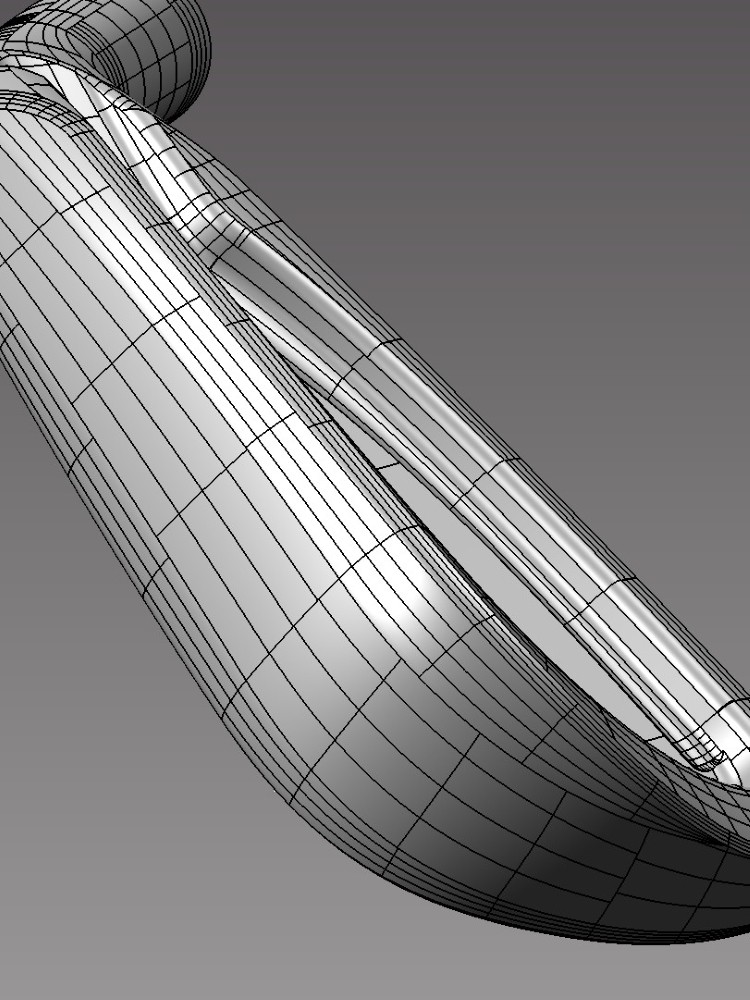
It is a bit difficult to describe, but it is a "one dimensional" view to evaluate the strength of the Vance effect only in terms of the Vance angle. The angle is ambiguous in terms of what it is in relation to, and in the end it is judged by whether it is too much or too little. In the end, we end up judging the angle based on whether it is too much or too little. Since we cannot reach the original performance in this way, I would like you to at least imagine the cross-section of the wedge and judge its wedge-shaped condition from a "two-dimensional" perspective.
By looking at the cross section, we can determine the difference in width and thickness of the sole, whether the sole is flat or round, and whether the ground contact position is in front or behind. Furthermore, is the contact position front or back? The angle of the sole is also important. The angle, for example, you can see that the wedge angle is the same for a loft of 56 degrees with 8 degrees of advance and for a loft of 60 degrees with 12 degrees of advance.
Even though it may be difficult to understand how these performances affect the effect at first, by being aware of them, you will gradually be able to see the conditions that suit your own hitting style.


To further understand this, I think it is important to take a "three dimensional" view that takes into account the changes in shape in the toe and heel directions. If we look at the rounding of the sole in this direction and the change when the wedge is opened, we will be able to see more of the wedge's true performance.
And beyond that, I value the "4-dimensional" view in my designs. I would like to talk about this in the next issue.


Thoughts on the Juicy Wedge lineup

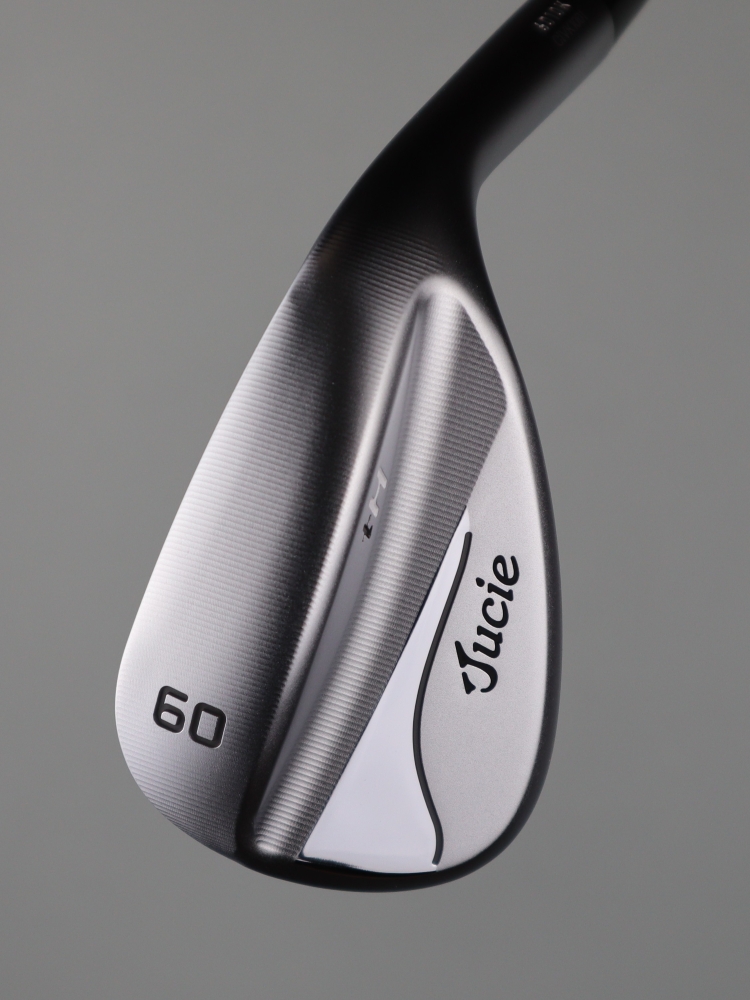
As I mentioned, the Juicy wedge series was created with these various performances in mind, and even just looking at the 58-degree wedges, there are five types: B, S, K, G, and T, each with its own unique performance. In particular, the B, S, and K wedges all have a 10-degree angle of incidence. If you choose them by angle, they are all the same, but S has the weakest valance effect, B is standard, and K is slightly stronger, and if you hit the ball, you will feel it immediately.
T sole has a special valance effect, which aims to increase the amount of spin at close distances in a stable manner. It has a good vance effect and a moderate vance effect when it is open.
And as for the G sole, the angle is 8 degrees, but the vance effect is about the same as the B sole, and furthermore, the roundness is adjusted slightly so that the same vance effect is exhibited as much as possible whether the wedge is used straight or open. Furthermore, when evolving the wedge as tT Wedge 2.0, we have slightly strengthened the vance effect to the same level as that of the K sole. Therefore, we hope that our customers will abandon their preconceived notions of "because it has an 8-degree angle" or "because it has a low-vance" and feel that we want them to choose not based on the numerical value of the vance angle, but rather on the index of how effectively the sole functions for the shots they want to hit.

What's the difference, JUCIE?

What I feel makes JUCIE different from others is the "fun of use," the "individuality of each club," and the presence of the designer, Mr. Muneyuki Matsuyoshi.
Rather than just talk about Mr. Matsuyoshi here, I would like to plan an opportunity for you to actually meet him at an event or other such occasion in the future. I am sure that what you feel when you hear him speak directly cannot be fully conveyed in writing.
So, for this article, I would like to focus on the club itself.


If you compare a club to a car...
I often think that it is easy to understand if you compare it to a car.
Cars have their own characteristics, such as agile handling, comfort, and capacity for a large group, etc. JUCIE's clubs also have distinct "personalities" depending on the model.

For example...

  • tH wedge: Stability and security. This is a model that gives you a sense of security that it is easy to use. I can say that this is my starting point.
  • tT wedge: A "manual car" model that reflects the golfer's intentions. Many people find it fun and easy to use.
  • tQ irons: Specializing in the beauty of the ball. An iron that makes you admire the way the ball flies when you hit it. This model is more about aesthetics than gentleness or distance.

When you put them side by side like this, you can see that the characters are really divided.


It changed my view of golf.
I myself used to think of the game of golf as "fighting against mistakes".
Reduce the number of mistakes and prevent the big ones. In the process, if you occasionally hit a miraculous shot or the "best shot of the day," it can lead to enjoyment and pleasure. For many people, this is the image of golf. But after I started using JUCIE, that impression has changed dramatically.
When I approach the ball, I think, "If I drop it here, it will roll this much."
"With this lie, I think I can pull it in with a soft ball."
When I use irons, I think I can aim at this height.
"Should I try a draw or a fade?"
Like that, "What should I do with this shot from now on? You have to concentrate on the image of "what I'm going to do with this shot now. This is something that should be obvious, but in reality, it is not easy to think that way. In many cases, the anxiety of "I don't want to top it" or "I'm going to slice it" comes first. That is a realistic situation, and it was the same for me. However, when I use JUCIE, my positive image of "this is how I want to hit the ball" becomes stronger than my negative imagination. As a result, the way I position myself and the position of the ball become natural, and I can concentrate on my play.


Depth of design
I learned later that JUCIE wedges are designed with the "role" of each position in mind. The wedges are designed in such a way that you can choose "this loft is easier to hit in this situation. This reduces hesitation in selecting the right club and creates a sense of security. In fact, you can even get excited about whether or not you will be able to "pull it off. Of course, it is human nature to make mistakes. But if you have faith in the club, you will soon give up and say, "That was my fault..." When you give up, you will soon be able to play again. When you give up, you can immediately switch to the next play. I think it is mentally very good for the long game of golf to be able to do this throughout the 18 holes.


What is conveyed through simplicity
The appeal of JUCIE is that it does not flashy high-tech, nor does it exaggerate the materials or manufacturing process. The seemingly simple design is filled with devices and ideas that "respond to the way golfers want to hit the ball" and "how to make golfers enjoy their game," which can be experienced in the real world of golf. That is why it is not "just a tool" but "a tool to enjoy golf more". I think that is the biggest difference of JUCIE.


Finally.
Even after writing like this, I still can't convey everything in writing.
In the end, I want you to pick it up, try it, and feel for yourself, "Oh, so this is what it is like.
And behind that, there is always the designer, Mr. Muneyuki Matsuyoshi. I believe that the "individuality" and "sense of security" conveyed from the clubs are the very essence of Mr. Matsuyoshi's philosophy. Also, this article is written from my subjective viewpoint, but I am sure that each user will feel something different.

Is it time to reset conventional wisdom regarding wedge selection? -Part 1-

I would like to talk about the thoughts we put into wedges as Juicy's products and the essence of wedge selection over several sessions.


Is it necessary to choose wedges based on spin performance?
Last time I mentioned that when I started Juicy, I wanted to get away from wedge design, and I recently had another conversation with a Juicy member that led to the essence of this question.

The impetus for this was actually reading a wedge feature written in a golf magazine over 30 years ago. In it, there was a lot of talk about incorporating more pure golfer sensation into performance, and of course, there was talk about applying spin through the vance effect, and so on. What came up again at that time was, "I have the impression that before the introduction of balls and wedges with high spin performance, there were even fewer people suffering from approach yips than there are now." And, "I don't think people thought of wedges as something difficult to use, but rather as an easy club to get out of bunkers." This is what I was thinking.

This is exactly the discomfort I felt in wanting to get out of wedge design. In no small part, I have been influenced by the creation of a market in which "wedges with high spin performance are easy to sell," and the same goes for the other indicator that has been constructed: "Wedges called low-vance are difficult. Wedges, like putters, are inherently an area that is not easily affected by head speed, so I think it is good if you can choose them as a club to help you regardless of your head speed. Of course, I had been designing wedges not only for spin performance but also for ease of use, but all I was asked was, "Will the new model have more spin?" On the other hand, I often heard people say that they had the approach yips.


How to control approach yips
When we started from zero as a new Juicy model, based on the request from the pros to create a model that they themselves genuinely wanted to use, we had the underlying feeling that if we created a truly easy-to-use model, it would surely please a wide variety of golfers, and furthermore, that wedge shots would be We wanted to make a club that would make wedge shots more enjoyable. I also vaguely hoped that it would help those who have trouble with the yips.
There are many causes and triggers for the yips, but I believe that a major factor is the frequent occurrence of "a shot that I hit with confidence turning out differently than expected.
I believe that there are three major ways to control the yips.
The first is to "use something with a completely different image." The first is to use a completely different image. I will talk about this later, but the chipper is the biggest example. On a narrower scale, for example, a person who has been doing various things with a single 58-degree club might change the setting to 55- and 60-degrees.
The second is "changing to a club that provides a sense of security to cover mistakes. This is a very big theme and the most challenging performance. We have a good solution in mind and would like to commercialize it someday.
The third is "use reliable tools. This is what I would like to share with you this time, and it is a theme that seems obvious but is quite difficult.


Not amazing spin, but spin as expected.
I think it is safe to assume that increased spin performance is really one of the reasons for the increase in approach yips. The spin generation mechanism of wedges is very complex, and it is not true that the spin performance that increases at 60 yards, for example, will have the same effect at 90 yards or 30 yards, but I feel that there are many wedges on the market that have increased spin performance in only one part of the wedge. However, I feel that there are many wedges on the market that have increased spin in only one part of the wedge, and when you use such wedges, you may get unexpected results, such as very strong spin or sudden lack of spin, which directly leads to the beginning of the yips.

I, too, was very surprised by the strong spin when I first hit a carved-groove wedge with a urethane-covered ball more than 20 years ago, and I felt like I was getting better at it, so from then on I wanted to use a lot of spin to stop the approach. However, from that time on, the pros consistently asked for more spin, not just more spin, but more spin that would make it easier to hit the shots I wanted to hit, such as not enough spin on any shot or too much spin on this shot. I believe that the essence of choosing a wedge based on spin performance is not the absolute amount of commercial spin, but the purpose of the wedge, which is to have consistent spin performance that allows you to hit the ball as far as possible from various lies and distances. If you are worried about the wedge yips, please review your current wedge objectively and ask yourself under what circumstances you can hit the "rare good shot with strong spin"? Can you hit it the same way at other distances? Is it reproducible? What were the situations in which you tended to make mistakes? Please think about these questions in an organized manner. And if you have any doubts, please try the tT Wedge 2.0 T-Sole. As we call this model our juicy flagship, we have packed all our know-how into it so that you can hit a consistent shot with the spin you expect on every shot. I have not particularly communicated this to you until now, but in fact, many people, including pros and top amateurs, have told me, "After I switched to the Juicy, I no longer get the yips." I am very happy to hear that more and more people, including professionals and top amateurs, have told me that they no longer get the yips after switching to Juicy.