

Previously, I discussed how sole performance should not be judged by a simple one-dimensional metric like sole angle, but rather two-dimensionally, considering thickness and width, and even three-dimensionally, accounting for changes in the toe-heel direction.
This time, I would like to discuss how being aware of the four-dimensional performance beyond these aspects can lead to a more satisfactory wedge selection, helping you understand what truly suits you, or why a particular club did not.
What is my concept of 4-dimensional club design?
Generally, three dimensions refer to space expressible by length × width × height. When I design golf clubs, within the physical constraints of what size and weight can be achieved in this space, I strive to enable golfers to execute their desired shots by considering factors such as shape and center of gravity performance.
To this, another dimension is added. In common interpretations, the fourth axis is considered time. Simply put, this interpretation stems from the idea that "even the same object cannot be precisely located if time differs." In the context of club design, this refers to the duration of a golfer's experience (knowledge and expertise). I believe it is crucial to keenly observe and discern how the demands placed on clubs evolve and become more specialized over time.
To illustrate a simple example: when addressing a club that is upright, some golfers will raise their hands to match the club's lie, while others will address the ball from their comfortable position, lifting the toe. Even this slight difference can significantly alter the outcome. When designing, I consider whether such differences stem from individual preference or accumulated experience, and which tendency aligns with the target profile of the club being developed.
Conversation between Roki Sasaki and his coach
The previous example was relatively simple, but I often engage in almost speculative analyses of how golfers' equipment usage differs based on deeper levels of experience. I once encountered something that felt like a concrete manifestation of such an analysis.
In an interview article about Major League pitcher Roki Sasaki's comeback after a period of poor form, he recounted a conversation with his coach. Alongside checking his current condition, asking "Which pitch type is easiest to throw?" and "Do you have any pain?", the coach also asked, "Is there anything a coach told you around fifth grade that you've continued to uphold?" This resonated strongly with my own subtle checks when designing clubs or recommending them. I was deeply impressed that such considerations are made at the forefront of Major League baseball for adjustments.
Wedges suited for experienced golfers
To elaborate, even with a single wedge shot, it's often not the optimal technique. However, I believe that golfers unconsciously adopt a swing they cherish as their own successful experience, sparked by a "eureka!" moment at some point. Furthermore, golfers who practice extensively and frequently change clubs can simply overwrite these insights. But for many, these experiences accumulate, and by the time they realize it, they might be repeating erroneous movements, mistakenly associating them with their ideal "nice shot," ultimately leading to repeated mis-hits.
A prime example is the "wedge shot that stops with backspin." Golfers often wish to consistently replicate a shot that was accidentally achieved due to the specific ball used at the time, the softness or slope of the green, or the interaction with grass and pebbles. When this desire becomes too strong, excessive expectations for low-probability shots can ultimately lead to the yips.
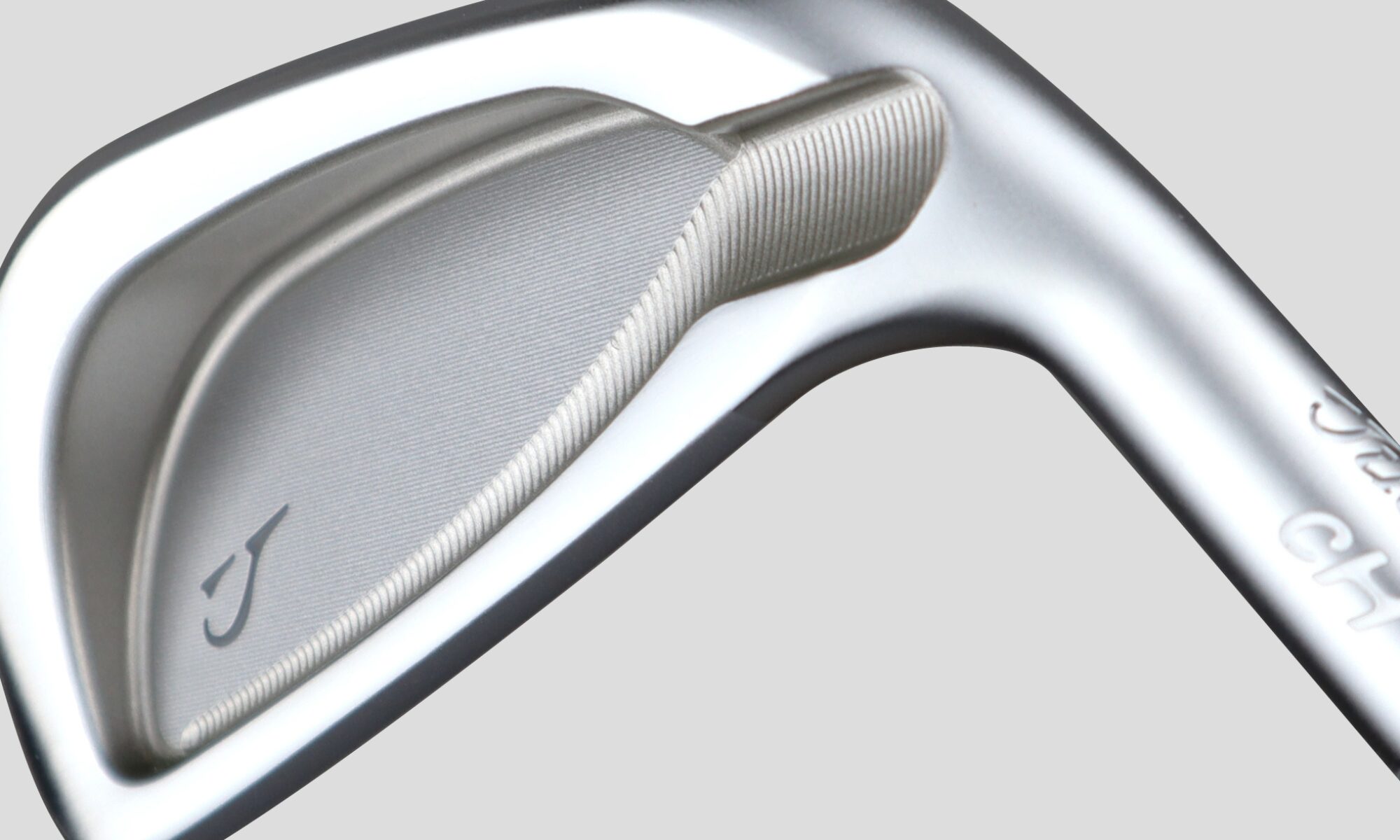
At such times, I want you to recall the swing you unconsciously discovered during your most dedicated practice, or the wedge shots you executed then. Instead of forcing a spin shot, you might have been aiming for a simpler approach. The ball itself might have been entirely different. It was with such golfers in mind that the Jucie tH Wedge series was designed. This model is intended for those who learned golf and practiced extensively before the advent of so-called "spin-oriented" wedges. Rather than merely replicating wedges from that era, we focused on designing a club that makes it easy for those golfers to execute simple wedge shots. We aimed for a shape that instills confidence while incorporating recent trends for easy setup. Additionally, there's the enjoyment of generating powerful spin by opening the face slightly. As a result, I believe this has become an excellent wedge that is easy for both seasoned golfers and newcomers to use simply.
Overwriting insights is also crucial.
Conversely, unconscious insights often do not align with the shot you currently wish to execute. In such cases, by envisioning the shot you want to play and selecting the wedge that facilitates it, even if you feel a little hesitant at first, gaining a new "eureka!" moment will lead to an enjoyable golf life where you evolve alongside your equipment.