
Beyond the "Easy-to-Use Club" - Part 2

As we enter 2026, I'd like to once again simply write down my thoughts behind Juicy's products and my goals for the future, continuing from last time.


We've released wedges with professional-level performance since our first model, and numerous pro golfers use them, winning multiple tournaments. It gives the impression, "Well, it's a pro model after all." However, the philosophy and dedication behind my design approach is slightly different. I'd like to explain this by comparing it to automotive performance.


What matters is high basic performance.

Cars and golf clubs are often grouped into broad categories, and in my view, sports cars feel like pro models while family cars feel like amateur models. Furthermore, working with tour pros gives the impression of serious racing participation, like a factory team. It feels like racing with cars that can't even be driven on public roads. That makes sports cars seem cool but unmanageable. You might even think pro models aren't actively chosen because they aren't driven fast in the first place.
But Juicy's models are a bit different. Think of them like rally cars competing in races based on production vehicles or in WRC. The key is that the base car is thoroughly engineered to be comfortable and enjoyable for everyday driving, while also possessing high fundamental performance that allows it to become incredibly fast through tuning and the driver's skill. Think of cars like the R32 GT-R, the first-generation Impreza, the Swift Sport, or the current Yaris.
Juicy clubs are designed with a deep awareness that, when paired with the right shaft and assembly method, they deliver comfortable performance even for the average golfer. Therefore, we want you to choose not because a pro model is difficult, but because your model is easy to use.
However, achieving this performance requires not only being a design professional, but also ensuring the fundamental performance is something professionals can recognize through tuning and use. Therefore, we will continue our works team activities diligently, constantly refining ourselves alongside professional golfers playing at the cutting edge, striving to keep creating clubs that bring joy to as many golfers as possible.


Is a car only good for its intended purpose?
Cars aren't just categorized by how fast they can go—they're also grouped by off-road capability, passenger and cargo capacity, fuel efficiency, and other specific goals. Within that framework, Juicy's core philosophy is to "aim for rally cars with high fundamental performance." Yet we constantly ask: Is a car only good for going fast?
About 25 years ago, I drove a compact sports car with a 1600cc engine producing 180 horsepower. Its power-to-displacement ratio set records for its time, and it featured 4WD and a manual transmission. However, due to the hassle of daily use, I switched to a compact SUV with three doors—something extremely rare back then.That car was marketed as a youth-oriented vehicle inspired by snowboarders, but I heard it sold particularly well to seniors.
The reason it was chosen seems to be that, back then, the term "SUV" wasn't yet established, and it fell into the category of vehicles prioritizing off-road capability, like cross-country vehicles. However, its ease of entry and exit, the high eye point, and the ease of driving over small bumps without worry were apparently more appreciated by the senior demographic. I truly believe the number of seniors driving compact SUVs has increased significantly now.


Clubs born from the field, creating new needs Something similar occasionally happens with golf clubs too. To give a recent example, one manufacturer released a model positioned as a club between a utility and a fairway wood.Upon actually checking its center of gravity performance, it appeared to me that while the ball flight was fairway wood-like, the swing feel was expected to be closer to an iron than a fairway wood. I felt it would be ideal for users who prefer iron-type UTs and desire a bit more spin.The result was fascinating: it increasingly got used that way, and with each model change, its specs shifted closer to an iron.
Just as compact SUVs evolved from being praised for qualities beyond their original purpose, golf clubs too can become new standards if their actual performance delivers what golfers seek—regardless of category.Furthermore, we want to firmly develop clubs that aren't specialized for a category, but instead offer a balanced ease of use – clubs with "performance that simply makes playing golf enjoyable." We also believe wedges and UTs still have significant potential for evolution and change. Therefore, we want to pursue even more, with a field-first approach, what kind of clubs actual golfers need.
We are considering various new initiatives to firmly capture such needs, so please look forward to them.

Beyond the "Easy-to-Use Club"

This time, I simply want to write about what thoughts I wish to put into golf club design as we approach 2026.


A key phrase frequently mentioned when discussing recent club performance is "usable easy clubs," as highlighted in the headline. Historically, pros and advanced players often preferred "usable difficult clubs" emphasizing control, while amateurs frequently used clubs that heavily compensated for poor swing mechanics or lack of speed—clubs that advanced players might deem "unusable easy clubs."However, since the widespread adoption of performance-measuring devices that provide quantifiable results, this trend has gradually shifted. Particularly, the significant evolution in the ease of hitting high-moment-of-inertia drivers has made this "ease" advantageous even for pros, leading to the emergence of "usable, easy-to-hit clubs." Since then, there seems to be a growing demand for "usable, easy-to-hit clubs" extending to fairway woods, utility clubs, and irons as well.


From tightrope walking to sturdy bridges
I often use the analogy of crossing a valley quickly to explain the evolution of clubs toward these large heads. When crossing a valley to the other side, small drivers like persimmon heads are like tightrope walking. In that era, only a handful of masters could balance and move quickly along the rope.The metalwood era was like a swaying suspension bridge. While still accompanied by the fear of falling, it was passable enough. Titanium drivers became a bridge that didn't sway. The era of high moment of inertia drivers is like a sturdy bridge with a wide roadway. At this point, as long as you didn't lose your direction, you could even run at full speed, and anyone could safely cross the valley. Professional golfers' skills shifted from requiring tightrope-walking mastery to needing the athletic ability to run fast.
So, what about irons? While the swing trend is becoming more athletic, they still can't be called sturdy bridges. They feel more like suspension bridges or narrow bridges without railings, even if they don't sway.Consequently, manufacturers are experimenting with various approaches to enhance performance. However, the current sales reality seems focused on the distance competition of the #7 iron. Rather than strengthening the suspension bridge, the trend has shifted towards excessive lightweighting and strong lofts – essentially, if you can't cross it fast, just tilt the bridge downhill.


The straightforward , logical argument is what I've written about so far. However , what I prioritize in my design approach for 2026 is to design with a deeper understanding that actual golfers incorporate and practice movements that are not ideal, either unconsciously or consciously. Using the earlier example, I found inspiration in an interesting story I heard from my mentor.
"When traversing a narrow ridge under harsh conditions like Everest, with a 4000m drop on the right and a 2000m drop on the left, falling either way means certain death. Yet, strangely, you find yourself wanting to lean left as you walk."If we use the analogy of crossing a valley, it's like being on a bridge that's safe to cross if you're not in such a hurry, yet you end up leaning toward the shallower side of the valley as you run. This is precisely the golfer's psychology we should focus on: often, driven by the sheer desire to avoid mistakes, we actively incorporate movements that deviate from the ideal. When this happens, even a "usable, forgiving club" won't produce the ideal ball flight, and a negative mindset seems likely to accumulate.
Furthermore, including the driver, many golfers still strongly believe that progressing like a tightrope walker is their familiar golf. Even on a wider bridge, they diligently maintain a meticulous swing, never neglecting to keep both hands level to maintain balance.


Juicy NEW Model Direction
Starting in 2026, Juicy aims to embark on a new chapter.
We will increase the number of clubs that deliver a truly "gentle" feel.
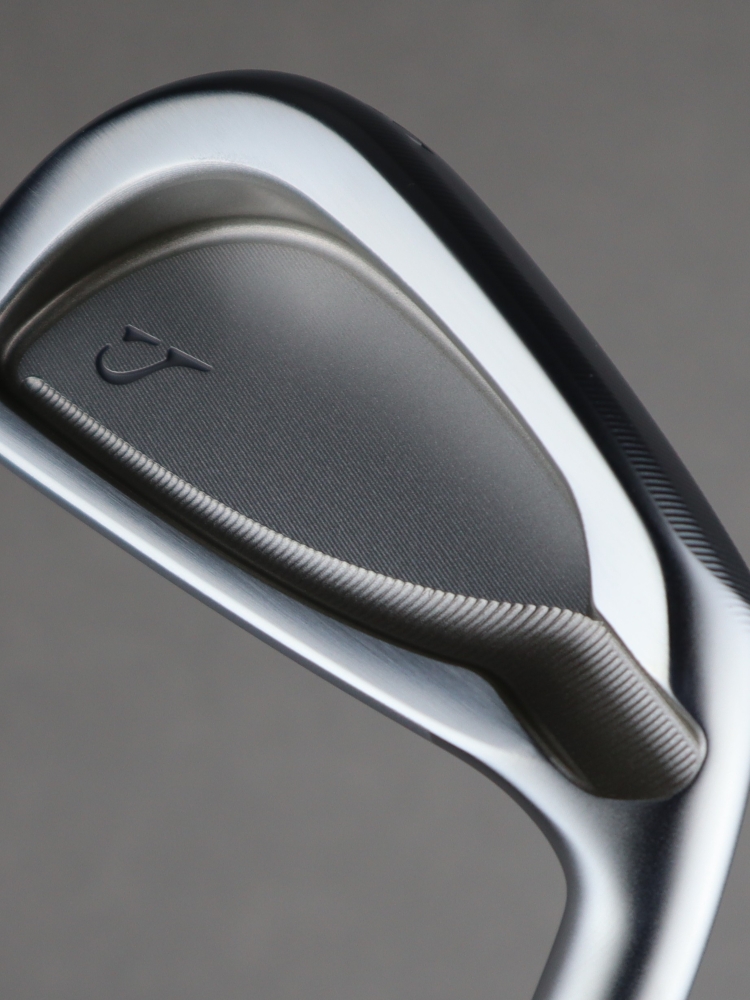
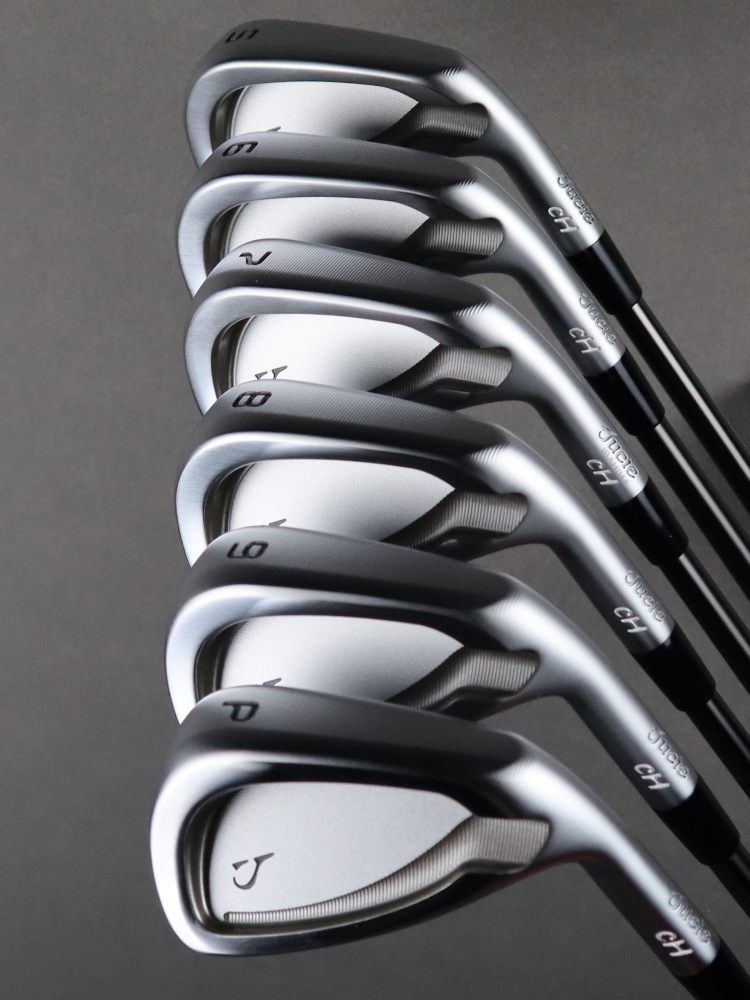
Using the analogy of crossing a valley, first, we must design clubs that are reliably sturdy, even if just a little, and with a wide path. This creates the "usable, gentle clubs" needed today. Furthermore, if many players tend to lean toward the shallower side of the valley, we will subtly design the path to slope deeper.Or, we could add a safety railing on the deeper side. And instead of an easy downhill bridge, we could subtly start with a gentle slope—providing just the right amount of assist to move forward with confidence. If you swing with your hands level, it should still feel great to run, with performance that makes feedback easy to feel. We aim to gradually develop a series that offers this kind of "ease" attuned to the golfer's mindset, allowing you to dash forward with confidence.

Can we reset the conventional wisdom of wedge selection? -Part 2

In the previous issue, we discussed how sole performance should be judged not in one dimension, such as sole angle, but in two dimensions, such as thickness and width, and in three dimensions, such as changes in the toe and heel directions.
This time, I would like to talk about how you can select a wedge more satisfactorily if you are aware of the 4-dimensional performance beyond that, such as what is right for you and why it is not right for you.


What is my definition of the 4 dimensions of club design?
Generally speaking, three dimensions are the space that can be represented by length x width x height. When I design a golf club, I consider the shape and center of gravity performance to realize how many desired shots can be hit within the physical constraints of what size and weight can be made in this space.
Another dimension is then added, and the general interpretation is that the fourth dimension is time. To put it very simply, the interpretation is that "even if the same object has a different time, its position cannot be determined. In club design, then, it is simply a matter of the length of time (experience and knowledge) that the user has been playing golf. We believe that we have to be very conscious of the fact that the requirements for clubs are changing and becoming more specific.
To put it simply, for example, when you hold a club that is upright, there are those who hold it with their hands up as per the club, and those who hold it in a position that is comfortable for them and float the toe. This difference alone can make a big difference in the outcome. We design our clubs by considering whether such differences are a result of individuality or experience, and which is the target image of the clubs we are designing. I design the clubs with these considerations in mind.


Conversation between Akinori Sasaki and his coach
The previous example is rather simple, but I have always had an almost delusional consideration of the differences in the way golfers use their tools depending on their experience, which is a little deeper than that, but there was something I felt concretely expressed such a consideration.
In an interview with major leaguer Akinori Sasaki, who had been in bad shape for a while and then made a comeback, he talked about his interactions with his coach, in which he asked, "Which pitches are easier to throw?" Does he have any pain? and "Do you have any pain?" as well as "Is there anything that your coach told you when you were in the 5th grade or so that you continue to follow?" I was asked. This is exactly what I do when I design a club, or when I am asked for a recommendation for a club, and I was very impressed by the fact that they are making adjustments with this kind of thing in mind at the cutting edge of major league baseball.


Wedges that suit golfers with long golfing experience
To be more specific, even if a single wedge shot is not always the best way to use a wedge, I believe that each golfer, at some point in his or her career, will have an inspiration that will lead him or her to hit the wedge in a way that he or she values and cherishes as his or her own successful experience. I believe that each golfer, at some point in his or her life, has an epiphany and unconsciously plays in a way that he or she values as a successful experience. However, in many cases, the golfer may be accumulating such inspirations, and when he or she realizes this, he or she may hit a move that is not necessarily correct for the equipment he or she is currently using as his or her image of a good shot, and as a result, may repeatedly hit a miss shot. As a result, you may end up repeatedly hitting a wrong shot.
A typical example is the "wedge shot with backspin to stop". This tends to be a shot that was created by accident due to the ball used at the time, the softness or slope of the green, or the bite of the grass or pebbles, and we always want to reproduce it. As this desire grows stronger, it can eventually lead to the yips due to excessive expectations for shots that have a low probability of success.
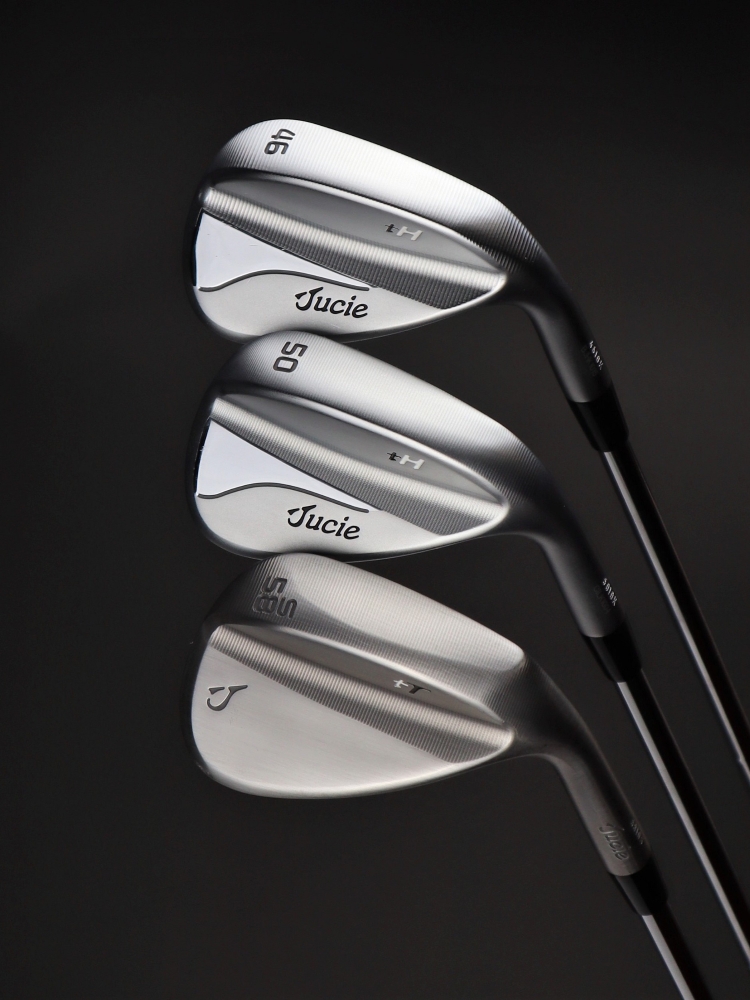
At such times, we would like you to remember the times when you were practicing the most, the shots that inspired you unconsciously, the wedge shots you were making at that time, and so on. Instead of forcing a spin shot, you might have pulled the ball in a simpler way. The ball might have been completely different. The Juicy tH wedge series was designed with such golfers in mind. This model is intended for those who learned to play golf and practiced a lot before the so-called spin wedges came out. Rather than simply recreating the wedges of that time, we have tried to design wedges that are easy for those who used to use them to hit simple wedge shots, and the shape is easy to set up and secure while keeping in mind recent trends. The wedges are also fun to use with a slightly open stance to generate strong spin. The result is a wedge that is simple and easy to use for those who have been playing golf for a long time, as well as for those who have just started playing.


Overriding inspiration is also important.
On the other hand, there are many cases where unconscious inspiration does not match the shot you want to hit at the moment. Even if you are a little confused at first, you will be able to find a new "this is it! If you get an inspiration, it will be an enjoyable golf life that will evolve together with your tools.

Can we reset the conventional wisdom of wedge selection? -Medium Edition- -Medium Edition

In the last issue, we talked about how you should focus not on absolute spin performance, but on "does it always produce the spin you expect?" I would like to talk about another uncomfortable point: "It is a waste of time to choose a wedge by giving priority to the value of the angle of the stance.
This time, I would like to talk about another uncomfortable point, which is that it is a waste of time to select wedges by giving priority to the value of the angle of the stance.


Is low-vance wedge difficult?

When was the low-vance wedge genre established...
When wedges were commonly included in iron sets, the Sw was a helpful club that was easy to use in bunkers, and when the trend toward strong lofts began to progress and the loft of the Pw was in the 40-degree range, clubs called the Then, clubs called W, Aw, Gw, P/S, etc. appeared between Pw and Sw, and simply the performance to fill the distance difference between Pw and Sw came to be demanded. After that, I feel that the clubs gradually evolved and changed into clubs specializing in handling bad lies close to Sw and clubs specializing in approach performance that can easily carve out a pitch of distance more than Pw.
Further changes occurred, and wedges were created as a series of wedges only, and even as a series of wedges with loft notation instead of number notation, the so-called single-piece wedge as we know it today.
Until then, wedges were all clubs that specialized in helping functions, such as clubs that specialized in getting out of bunkers or clubs that specialized in rolling, as typified by chippers.
It was professional golfers who actively adopted these single-purpose wedges, and they were transformed into various types of performance to meet the demands of various players. A major element of this change was mainly in sole performance, with clubs being created to suit those who used the sole aggressively and those who preferred a sole that did not get in the way at various angles of incidence.

The high-spin wedge was the first to appear on the scene. These high-spin wedges, depending on the sharpness of the scoreline and the performance of the ball at the time, were compatible with those with a strong sole performance, so the number of models with a strong vance effect increased. The early low-vance wedges were created for professionals who did not follow this trend and preferred a model with a weak vance effect that made it easier to hit a variety of shots rather than spin performance.
And because the people who used these low-vance wedges were skilled in wedge work at the time, wedges that incorporated their opinions often had sharp performance, and as a result, the impression that low-vance wedges were difficult became firmly established.


Low Vance ≠ Smaller Vance Angle

So what does low-vance mean in the first place?
I would describe it as having a "low-vance effect". I don't simply say that the angle of the vance is small. However, it is commonly accepted that they are synonymous in the current wedge selection process.
It is a bit difficult to describe, but it is a "one dimensional" view to evaluate the strength of the Vance effect only in terms of the Vance angle. The angle is ambiguous in terms of what it is in relation to, and in the end it is judged by whether it is too much or too little. In the end, we end up judging the angle based on whether it is too much or too little. Since we cannot reach the original performance in this way, I would like you to at least imagine the cross-section of the wedge and judge its wedge-shaped condition from a "two-dimensional" perspective.
By looking at the cross section, we can determine the difference in width and thickness of the sole, whether the sole is flat or round, and whether the ground contact position is in front or behind. Furthermore, is the contact position front or back? The angle of the sole is also important. The angle, for example, you can see that the wedge angle is the same for a loft of 56 degrees with 8 degrees of advance and for a loft of 60 degrees with 12 degrees of advance.
Even though it may be difficult to understand how these performances affect the effect at first, by being aware of them, you will gradually be able to see the conditions that suit your own hitting style.


To further understand this, I think it is important to take a "three dimensional" view that takes into account the changes in shape in the toe and heel directions. If we look at the rounding of the sole in this direction and the change when the wedge is opened, we will be able to see more of the wedge's true performance.
And beyond that, I value the "4-dimensional" view in my designs. I would like to talk about this in the next issue.


Thoughts on the Juicy Wedge lineup

As I mentioned, the Juicy wedge series was created with these various performances in mind, and even just looking at the 58-degree wedges, there are five types: B, S, K, G, and T, each with its own unique performance. In particular, the B, S, and K wedges all have a 10-degree angle of incidence. If you choose them by angle, they are all the same, but S has the weakest valance effect, B is standard, and K is slightly stronger, and if you hit the ball, you will feel it immediately.
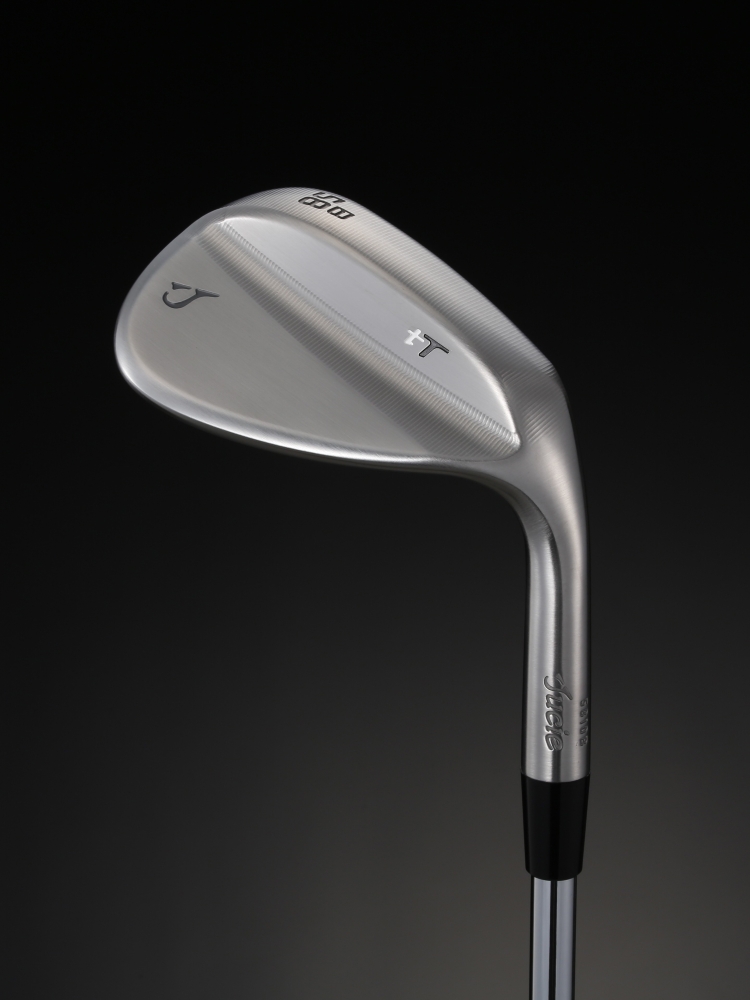
T sole has a special valance effect, which aims to increase the amount of spin at close distances in a stable manner. It has a good vance effect and a moderate vance effect when it is open.
And as for the G sole, the angle is 8 degrees, but the vance effect is about the same as the B sole, and furthermore, the roundness is adjusted slightly so that the same vance effect is exhibited as much as possible whether the wedge is used straight or open. Furthermore, when evolving the wedge as tT Wedge 2.0, we have slightly strengthened the vance effect to the same level as that of the K sole. Therefore, we hope that our customers will abandon their preconceived notions of "because it has an 8-degree angle" or "because it has a low-vance" and feel that we want them to choose not based on the numerical value of the vance angle, but rather on the index of how effectively the sole functions for the shots they want to hit.

Can we reset the conventional wisdom of wedge selection? -Part 1

I would like to talk about the thoughts we put into wedges as Juicy's products and the essence of wedge selection over several sessions.


Is it necessary to choose wedges based on spin performance?
Last time I mentioned that when I started Juicy, I wanted to get away from wedge design, and I recently had another conversation with a Juicy member that led to the essence of this question.

The impetus for this was actually reading a wedge feature written in a golf magazine over 30 years ago. In it, there was a lot of talk about incorporating more pure golfer sensation into performance, and of course, there was talk about applying spin through the vance effect, and so on. What came up again at that time was, "I have the impression that before the introduction of balls and wedges with high spin performance, there were even fewer people suffering from approach yips than there are now." And, "I don't think people thought of wedges as something difficult to use, but rather as an easy club to get out of bunkers." This is what I was thinking.

This is exactly the discomfort I felt in wanting to get out of wedge design. In no small part, I have been influenced by the creation of a market in which "wedges with high spin performance are easy to sell," and the same goes for the other indicator that has been constructed: "Wedges called low-vance are difficult. Wedges, like putters, are inherently an area that is not easily affected by head speed, so I think it is good if you can choose them as a club to help you regardless of your head speed. Of course, I had been designing wedges not only for spin performance but also for ease of use, but all I was asked was, "Will the new model have more spin?" On the other hand, I often heard people say that they had the approach yips.


How to control approach yips
When we started from zero as a new Juicy model, based on the request from the pros to create a model that they themselves genuinely wanted to use, we had the underlying feeling that if we created a truly easy-to-use model, it would surely please a wide variety of golfers, and furthermore, that wedge shots would be We wanted to make a club that would make wedge shots more enjoyable. I also vaguely hoped that it would help those who have trouble with the yips.
There are many causes and triggers for the yips, but I believe that a major factor is the frequent occurrence of "a shot that I hit with confidence turning out differently than expected.
I believe that there are three major ways to control the yips.
The first is to "use something with a completely different image." The first is to use a completely different image. I will talk about this later, but the chipper is the biggest example. On a narrower scale, for example, a person who has been doing various things with a single 58-degree club might change the setting to 55- and 60-degrees.
The second is "changing to a club that provides a sense of security to cover mistakes. This is a very big theme and the most challenging performance. We have a good solution in mind and would like to commercialize it someday.
The third is "use reliable tools. This is what I would like to share with you this time, and it is a theme that seems obvious but is quite difficult.


Not amazing spin, but spin as expected.
I think it is safe to assume that increased spin performance is really one of the reasons for the increase in approach yips. The spin generation mechanism of wedges is very complex, and it is not true that the spin performance that increases at 60 yards, for example, will have the same effect at 90 yards or 30 yards, but I feel that there are many wedges on the market that have increased spin performance in only one part of the wedge. However, I feel that there are many wedges on the market that have increased spin in only one part of the wedge, and when you use such wedges, you may get unexpected results, such as very strong spin or sudden lack of spin, which directly leads to the beginning of the yips.

I, too, was very surprised by the strong spin when I first hit a carved-groove wedge with a urethane-covered ball more than 20 years ago, and I felt like I was getting better at it, so from then on I wanted to use a lot of spin to stop the approach. However, from that time on, the pros consistently asked for more spin, not just more spin, but more spin that would make it easier to hit the shots I wanted to hit, such as not enough spin on any shot or too much spin on this shot. I believe that the essence of choosing a wedge based on spin performance is not the absolute amount of commercial spin, but the purpose of the wedge, which is to have consistent spin performance that allows you to hit the ball as far as possible from various lies and distances. If you are worried about the wedge yips, please review your current wedge objectively and ask yourself under what circumstances you can hit the "rare good shot with strong spin"? Can you hit it the same way at other distances? Is it reproducible? What were the situations in which you tended to make mistakes? Please think about these questions in an organized manner. And if you have any doubts, please try the tT Wedge 2.0 T-Sole. As we call this model our juicy flagship, we have packed all our know-how into it so that you can hit a consistent shot with the spin you expect on every shot. I have not particularly communicated this to you until now, but in fact, many people, including pros and top amateurs, have told me, "After I switched to the Juicy, I no longer get the yips." I am very happy to hear that more and more people, including professionals and top amateurs, have told me that they no longer get the yips after switching to Juicy.