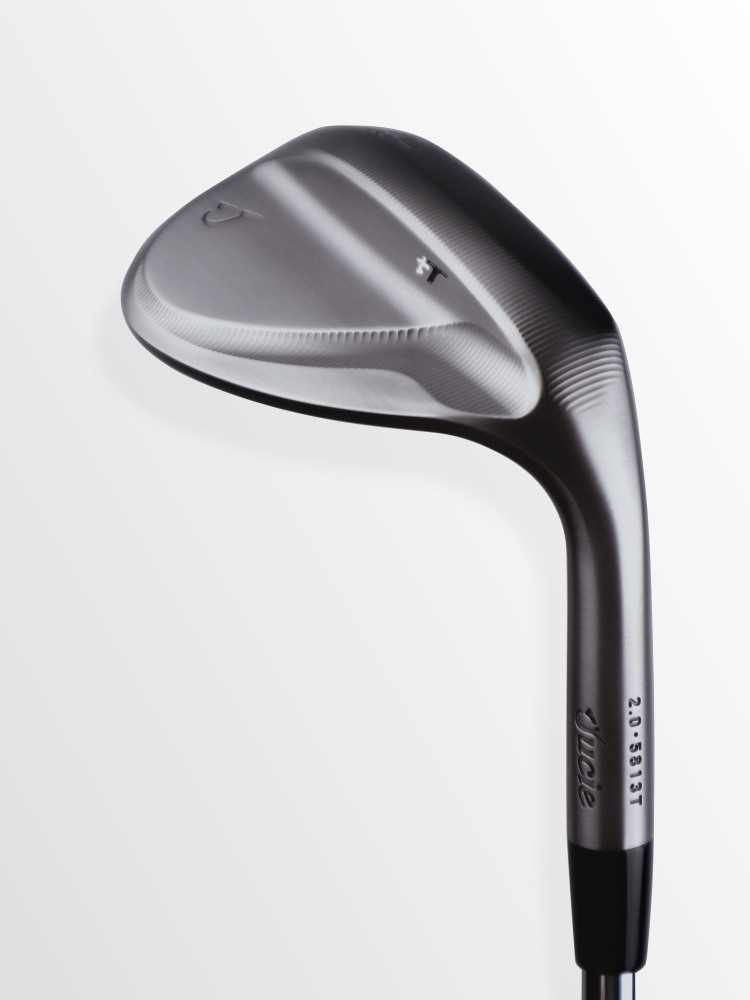
Juicy tT Wedge 2.0 will be offered as a tax return gift from Takasaki City. The existing tT wedge tH wedge is also continuing. For more details, please click here.

Join us for Jucie golf life.
Juicy tT Wedge 2.0 will be offered as a tax return gift from Takasaki City. The existing tT wedge tH wedge is also continuing. For more details, please click here.

Nice to meet you. My name is tK and I am the editor of this blog.
Although I give lessons for a living, I have always been just a user of JUCIE. I am also a golfer who has been immersed in the world of golf in my own way, and have repeatedly been troubled, improved, and depressed again. However, it is a little strange for me to be writing a blog about the JUCIE brand and its designer, Muneyuki Matsuyoshi.
This time, I would like to write about my encounter with Mr. Matsuyoshi of JUCIE. First of all, let me tell you that I am an enthusiastic fan of Mr. Matsuyoshi and the JUCIE brand. Yes, I am aware of it. So, I may be a bit hot and bothered, but please forgive me for that.
We met in 2023. The days of losing a score if you miss the green
I believe that was around the beginning of the year 2023.
At that time, I was playing golf in a very unstable way, as if I would lose a shot if I missed the green. If my shots were good, my score was good. But if my shots were a little shaky, I was out of control. I was especially bad at approaches, and was stuck in a negative loop of "I can't get close, it falls apart, and I give up. Then, through a friend of mine, I was told, "Why don't you consult Mr. Matsuyoshi of JUCIE? Mr. Matsuyoshi of JUCIE.
Mr. Matsuyoshi - I knew his name; he was the right-hand man of the late Takamitsu Takebayashi, who had made Japanese club design world-famous at F Corporation, and had inherited his DNA. He is a rather awe-inspiring person to consult with.
But I went there.
And suddenly, "Do you want to try hitting?" and asked me to accompany him to a nearby driving range, where he explained each model and let me try out all the wedges.
But...to be honest, at that point, I couldn't really pinpoint what the difference was.
Looking back, I myself did not understand the wedges at all. I didn't know what to feel, how to use it, and I guess I didn't have the sensitivity to "feel" the individuality of the club itself.
Even so, I bought the 60° tH wedge 6010K, which I found "somewhat easy to use" at that time.
Once I put the sole to the ground, everything changed.
The day I received that club, I was excited to go to the driving range.
To be honest, I still don't know what my excitement at the time stemmed from. Was it because I had a new club in my hand, or was it the desire for ownership of a luxury piece of equipment? ......
Before using the wedge, there was a quote by Matsuyoshi that remained in a corner of my mind.
He said, "A wedge is the sole. It's important that when the sole hits the ground, it matches the way the person wants to hit the ball."
Thinking back to those words, I consciously hit the ball with the sole against the mat--
and wow, the head goes under the ball with ease. It was as if the club was doing it on its own.
I thought, "What? I didn't realize how easy it was to approach?"
It was a strange feeling, and for the first time in my life, I felt that wedges were fun.
When your approach changes, your whole golf game changes.
The wonder of it all became a certainty a month later at a competition.
The greens were hard, fast, and 11.8 feet. The greens were hard, fast, and 11.8 feet, conditions that would have made me give up and say, "I'm not going to make it today.
However, on the par 4 green, my 20-yard approach from the boulevard came within 1 meter without any hesitation.
It may look like a "normal" approach from the side.
But in my mind, I thought, "What? I could hit it normally, but..." I felt uncomfortable. And it continued for the rest of the day.
You don't have to be afraid of hitting off the green.
If you hit it with the sole, the club will pick it up on its own. So you can concentrate on the landing area and line.
And with the tH Wedge 6010K, I had been taught not to apply too much spin and to make the most of the ball foot, so I had the feeling that the ball would naturally come close to where I was aiming without any extra manipulation.
I never knew an approach could be so reassuring."
Since then, any sense of aversion to the approach disappeared.
And then I realized. When my approach becomes stable, my whole golf game flows so much better.
To use an analogy...it's like being a baseball pitcher with a super-ironclad defense. Even if you get hit a little, someone will definitely get it. That's why you can pitch with confidence. That's how I felt.
I also felt this way.
I was neither attacking nor defending. It is not just a "bridge. It is not just a "connection." It is an absolute foundation that creates a sense of security. That is my impression.
As a result, I was the gross winner that day among more than a dozen other seniors who were in the lesson business.
I was surprised myself, but what made me happier was that I enjoyed golf and my approach. I really enjoyed it.
The "quiet madman" named Muneyuki Matsuyoshi
From there, I could no longer stop wondering, "Why is he so different?" I went back to Mr. Matsuyoshi again.
I went back to Mr. Matsuyoshi and asked, "Do wedges really differ that much?"
Does the shape of the sole have this much of an effect?"
I asked a lot of layman's questions, and Mr. Matsuyoshi answered them all politely and with a soft-spoken manner. However, the more I listened to him, the more I began to think, "I don't know.
Oh, he's a little crazy." In a good way, of course.
I don't get that impression at all because he answers all my questions in a soft-spoken manner. However, the more I learn about the depth of his conversation, the more I cannot help but feel that there is something "insane" about him.
Matsuyoshi is thinking about clubs on a completely different level from what we know about clubs. He draws a club from scratch on a blank computer screen, and although I have never actually seen him do it, I am sure that it is an insane world where no one can enter, where thoughts, numbers, and aesthetics continue to walk a tightrope.
The story we are being told is only a small part of it. We can't even imagine how many oceans of thought and design are spread out behind it - we can't even imagine.
From brands to people. And what I will continue to convey.
I started out with the brand JUCIE.
But now I am a fan of the "person" Muneyuki Matsuyoshi.
Thanks to him, I was given the opportunity to write this blog. I still think it is a mysterious fate.
I hope to continue to communicate JUCIE and Mr. Matsuyoshi's thoughts and philosophy on club design from the perspective of a fan and user.
We would be happy if we could make the contents of this website such that readers would want to dive into the "deep sea" of Mr. Muneyuki Matsuyoshi.
See you then.
From tK
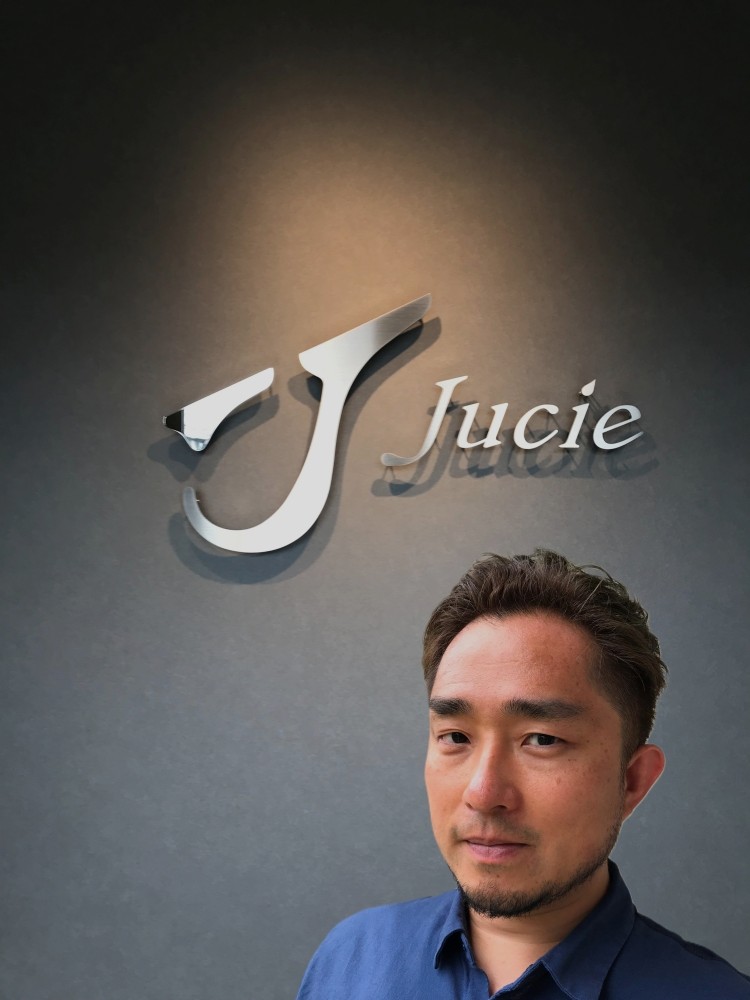
Hello everyone. I am Muneyuki Matsuyoshi, a.k.a. Juicy MATSU, the president of Juicy Corporation.
As some of you may know, since September 2019, I have been writing quite maniac contents on my Facebook account under the name of Juicy Matsu about the performance of golf clubs and the daily thoughts of the designer, etc. From now on, I will move to this place to transmit a variety of information. I will be moving to this location in the future and will be posting a variety of information.
Never cut corners on ideas
In this first installment, I would like to explain once again my thoughts on the founding of Juicy Corporation.
I started my career in the golf industry at a golf club design company, which is quite unique in the world. The founder of the company, my mentor, was a pioneer in the evaluation and design of golf clubs by quantifying club performance based on the center of gravity, something that seems rather commonplace today. Because of this start, naturally I am good at creating club performance by designing the center of gravity, but there is a thought that I value more than that, and that is a phrase that was written in a casual e-mail exchange with my mentor: "Never cut corners in your thinking. The longer one's career goes on, the more one tends to do the same kind of work, solve it with experience, and do safe work with no failures. Especially when we get a good success experience, we are afraid to get out of it, and it becomes like a routine pattern. At such times, we should remember these words, even about trivial things, and always ask ourselves as a developer, "Is this method a good choice now? I always go back to the time when I first thought about the method and keep thinking about a better choice.
New performance that fits you
A major decision in this line of thinking was to launch Juicy Corporation. While I had learned the design philosophy of continuing to develop golf clubs with unprecedented performance, I was bothered by the fact that the golf industry as a whole, not just our own company, had somehow become an environment that demanded the development of safe clubs that fit the cycle of economic activity.
Through marketing and by listening to the voices of golfers, we have been able to incorporate their ideas of "what kind of clubs they want" and "similar performance to that manufacturer's clubs" into the development process and respond to their requests with sincerity. Development that responds with sincerity. It is natural for a profit-seeking company to make plans with a firm awareness of sales, and there is nothing wrong with that. However, the golf club design that I have cultivated has been to design golf clubs as a tool, not as a product, to make what was not possible possible possible possible. We established Juicy Corporation with the thought that by doing so, we could contribute to the evolution and development of golf clubs, even if only a little.
We hope that our customers will be surprised to find clubs that they never thought existed, that are unlike any other clubs, and that when they use them, they will realize that they have found the right performance for them. I would like to continue to create golf clubs that are filled with unknown excitement, so that when you use them, you will think that this is the right performance for you.
Not a difficult model, but a model that makes it easy to hit good shots.
When I started the Juicy brand, I initially wanted to step away from wedge design for a bit. I have designed more than 30 models of wedges alone, and have created hundreds of wedges by number. Even the face shape has never been the same for all of them, and I have always drawn the wedges from scratch in 3D space. The accumulation of these designs sometimes felt heavy, and we wondered if the performance we had pursued had really been useful to golfers. I was asking myself, "Has the performance I have been pursuing really been useful to golfers? Just then, professional golfers who have been our customers for many years told us that it would be very difficult for them to lose the wedges they wanted to use. We received many requests from them, "Can you somehow make a new one? We have received many requests from them. Furthermore, due to changes in balls, course settings, and club settings, we received requests for wedges that make it easier to hit better shots, and these requests varied from pro to pro and were surprisingly common. We then considered whether there was a way to respond to each professional's request in a detailed and precise manner from a zero-based approach, and to do so immediately, anytime, any number of times, and the result was the "tT wedge. By using the machining method, which was rare except for putters at the time, we were able to supply a variety of models precisely and repeatedly, and professional golfers came to trust us even more than before. This is how the tT wedge was born as a personal model wedge for professional golfers, but since all of their demands are not "difficult" but rather a club that allows them to hit the shots they want more easily and without making mistakes, the tT wedge is not a difficult model. The tT wedge is not a difficult model at all, but rather a club that allows you to hit the shots you want more easily and without making mistakes.