
Can we reset the conventional wisdom of wedge selection? -Part 1

I would like to talk about the thoughts we put into wedges as Juicy's products and the essence of wedge selection over several sessions.


Is it necessary to choose wedges based on spin performance?
Last time I mentioned that when I started Juicy, I wanted to get away from wedge design, and I recently had another conversation with a Juicy member that led to the essence of this question.

The impetus for this was actually reading a wedge feature written in a golf magazine over 30 years ago. In it, there was a lot of talk about incorporating more pure golfer sensation into performance, and of course, there was talk about applying spin through the vance effect, and so on. What came up again at that time was, "I have the impression that before the introduction of balls and wedges with high spin performance, there were even fewer people suffering from approach yips than there are now." And, "I don't think people thought of wedges as something difficult to use, but rather as an easy club to get out of bunkers." This is what I was thinking.

This is exactly the discomfort I felt in wanting to get out of wedge design. In no small part, I have been influenced by the creation of a market in which "wedges with high spin performance are easy to sell," and the same goes for the other indicator that has been constructed: "Wedges called low-vance are difficult. Wedges, like putters, are inherently an area that is not easily affected by head speed, so I think it is good if you can choose them as a club to help you regardless of your head speed. Of course, I had been designing wedges not only for spin performance but also for ease of use, but all I was asked was, "Will the new model have more spin?" On the other hand, I often heard people say that they had the approach yips.


How to control approach yips
When we started from zero as a new Juicy model, based on the request from the pros to create a model that they themselves genuinely wanted to use, we had the underlying feeling that if we created a truly easy-to-use model, it would surely please a wide variety of golfers, and furthermore, that wedge shots would be We wanted to make a club that would make wedge shots more enjoyable. I also vaguely hoped that it would help those who have trouble with the yips.
There are many causes and triggers for the yips, but I believe that a major factor is the frequent occurrence of "a shot that I hit with confidence turning out differently than expected.
I believe that there are three major ways to control the yips.
The first is to "use something with a completely different image." The first is to use a completely different image. I will talk about this later, but the chipper is the biggest example. On a narrower scale, for example, a person who has been doing various things with a single 58-degree club might change the setting to 55- and 60-degrees.
The second is "changing to a club that provides a sense of security to cover mistakes. This is a very big theme and the most challenging performance. We have a good solution in mind and would like to commercialize it someday.
The third is "use reliable tools. This is what I would like to share with you this time, and it is a theme that seems obvious but is quite difficult.


Not amazing spin, but spin as expected.
I think it is safe to assume that increased spin performance is really one of the reasons for the increase in approach yips. The spin generation mechanism of wedges is very complex, and it is not true that the spin performance that increases at 60 yards, for example, will have the same effect at 90 yards or 30 yards, but I feel that there are many wedges on the market that have increased spin performance in only one part of the wedge. However, I feel that there are many wedges on the market that have increased spin in only one part of the wedge, and when you use such wedges, you may get unexpected results, such as very strong spin or sudden lack of spin, which directly leads to the beginning of the yips.

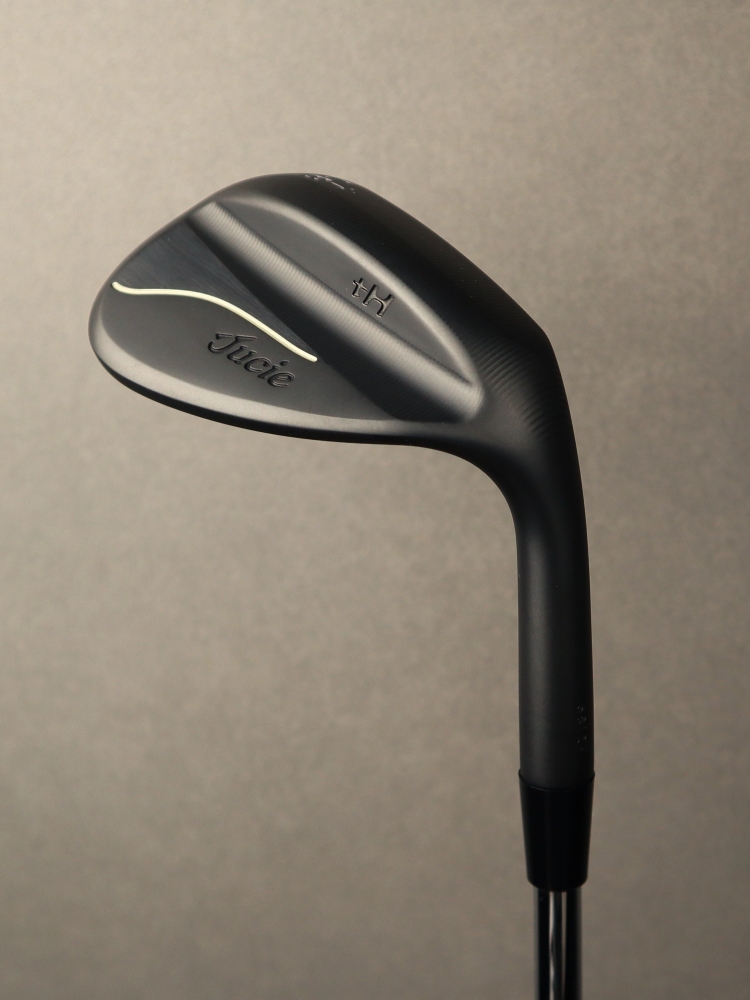
I, too, was very surprised by the strong spin when I first hit a carved-groove wedge with a urethane-covered ball more than 20 years ago, and I felt like I was getting better at it, so from then on I wanted to use a lot of spin to stop the approach. However, from that time on, the pros consistently asked for more spin, not just more spin, but more spin that would make it easier to hit the shots I wanted to hit, such as not enough spin on any shot or too much spin on this shot. I believe that the essence of choosing a wedge based on spin performance is not the absolute amount of commercial spin, but the purpose of the wedge, which is to have consistent spin performance that allows you to hit the ball as far as possible from various lies and distances. If you are worried about the wedge yips, please review your current wedge objectively and ask yourself under what circumstances you can hit the "rare good shot with strong spin"? Can you hit it the same way at other distances? Is it reproducible? What were the situations in which you tended to make mistakes? Please think about these questions in an organized manner. And if you have any doubts, please try the tT Wedge 2.0 T-Sole. As we call this model our juicy flagship, we have packed all our know-how into it so that you can hit a consistent shot with the spin you expect on every shot. I have not particularly communicated this to you until now, but in fact, many people, including pros and top amateurs, have told me, "After I switched to the Juicy, I no longer get the yips." I am very happy to hear that more and more people, including professionals and top amateurs, have told me that they no longer get the yips after switching to Juicy.

Juicy Matsu starts in earnest - "Origin" of JUCIE

Hello everyone. I am Muneyuki Matsuyoshi, a.k.a. Juicy MATSU, the president of Juicy Corporation.
As some of you may know, since September 2019, I have been writing quite maniac contents on my Facebook account under the name of Juicy Matsu about the performance of golf clubs and the daily thoughts of the designer, etc. From now on, I will move to this place to transmit a variety of information. I will be moving to this location in the future and will be posting a variety of information.


Never cut corners on ideas
In this first installment, I would like to explain once again my thoughts on the founding of Juicy Corporation.
I started my career in the golf industry at a golf club design company, which is quite unique in the world. The founder of the company, my mentor, was a pioneer in the evaluation and design of golf clubs by quantifying club performance based on the center of gravity, something that seems rather commonplace today. Because of this start, naturally I am good at creating club performance by designing the center of gravity, but there is a thought that I value more than that, and that is a phrase that was written in a casual e-mail exchange with my mentor: "Never cut corners in your thinking. The longer one's career goes on, the more one tends to do the same kind of work, solve it with experience, and do safe work with no failures. Especially when we get a good success experience, we are afraid to get out of it, and it becomes like a routine pattern. At such times, we should remember these words, even about trivial things, and always ask ourselves as a developer, "Is this method a good choice now? I always go back to the time when I first thought about the method and keep thinking about a better choice.


New performance that fits you
A major decision in this line of thinking was to launch Juicy Corporation. While I had learned the design philosophy of continuing to develop golf clubs with unprecedented performance, I was bothered by the fact that the golf industry as a whole, not just our own company, had somehow become an environment that demanded the development of safe clubs that fit the cycle of economic activity.
Through marketing and by listening to the voices of golfers, we have been able to incorporate their ideas of "what kind of clubs they want" and "similar performance to that manufacturer's clubs" into the development process and respond to their requests with sincerity. Development that responds with sincerity. It is natural for a profit-seeking company to make plans with a firm awareness of sales, and there is nothing wrong with that. However, the golf club design that I have cultivated has been to design golf clubs as a tool, not as a product, to make what was not possible possible possible possible. We established Juicy Corporation with the thought that by doing so, we could contribute to the evolution and development of golf clubs, even if only a little.
We hope that our customers will be surprised to find clubs that they never thought existed, that are unlike any other clubs, and that when they use them, they will realize that they have found the right performance for them. I would like to continue to create golf clubs that are filled with unknown excitement, so that when you use them, you will think that this is the right performance for you.


Not a difficult model, but a model that makes it easy to hit good shots.
When I started the Juicy brand, I initially wanted to step away from wedge design for a bit. I have designed more than 30 models of wedges alone, and have created hundreds of wedges by number. Even the face shape has never been the same for all of them, and I have always drawn the wedges from scratch in 3D space. The accumulation of these designs sometimes felt heavy, and we wondered if the performance we had pursued had really been useful to golfers. I was asking myself, "Has the performance I have been pursuing really been useful to golfers? Just then, professional golfers who have been our customers for many years told us that it would be very difficult for them to lose the wedges they wanted to use. We received many requests from them, "Can you somehow make a new one? We have received many requests from them. Furthermore, due to changes in balls, course settings, and club settings, we received requests for wedges that make it easier to hit better shots, and these requests varied from pro to pro and were surprisingly common. We then considered whether there was a way to respond to each professional's request in a detailed and precise manner from a zero-based approach, and to do so immediately, anytime, any number of times, and the result was the "tT wedge. By using the machining method, which was rare except for putters at the time, we were able to supply a variety of models precisely and repeatedly, and professional golfers came to trust us even more than before. This is how the tT wedge was born as a personal model wedge for professional golfers, but since all of their demands are not "difficult" but rather a club that allows them to hit the shots they want more easily and without making mistakes, the tT wedge is not a difficult model. The tT wedge is not a difficult model at all, but rather a club that allows you to hit the shots you want more easily and without making mistakes.